HC Delhi (2024.08.02) in Smt. Nisha Devi Vs. Shri Gur Kirpal Singh @ Guddu. [(2024) ibclaw.in 742 HC, CRL.M.C.792/2021, CRL.M.A.21694/2023 ] held that;
In having so proceeded, there is a satisfaction of the voluntariness and legality of the terms of the settlement of the court and acceptance of the terms thereof as well as a specific order in terms thereof. Consequently, the amount payable under the settlement, would become an amount payable under an order of the criminal court.
So far as the disputes beyond the subject matter of the litigation is concerned, upon the settlement receiving ‘imprimatur’ of the court, such settlement would remain binding upon the parties and if so ordered, would be subject to the orders of the court.”
in case, the matter is referred to mediation. Thereupon, it becomes imperative for the Court to be satisfied that not only the agreement is lawful but the same is with the consent of the parties and was voluntary without any force, pressure or undue coercion.
Under Section 26 of the Mediation Act, 2023, the ‘mediation settlement agreement’ resulting from mediation signed by the parties and authenticated by the Mediator is final and binding between the parties and is enforceable under the provisions of Code of Civil Procedure, 1908 by virtue of Section 27 of the Mediation Act, 2023, in the same manner as if it were a ‘judgment or a decree’ passed by the Court.
However, the ‘outcome of mediation’ in respect of compoundable offences forwarded for mediation shall not be deemed to be a judgment or a decree and shall be further considered by the Court in accordance with law for the time being in force, under second proviso to Section 6 of the Mediation Act, 2023.
As such, even though offence under Section 138 N.I. Act is quasi criminal in nature, the ‘outcome of settlement’ in mediation is required to receive imprimatur or authoritative approval of the Court, in case the proceedings are settled in mediation.
Having satisfied itself as to the voluntariness and legality of the settlement and recording the necessary statement/undertaking, the settlement becomes binding on the parties and cannot be retracted or resiled until and unless sufficient reasons are shown to reasonably infer that the settlement was under threat, pressure or coercion.
There is no bar that unless the matter is forwarded to mediation for settlement, the same cannot be entered before the Court itself. The Court only needs to be satisfied that the settlement is lawful and consent of the parties is voluntary and not obtained under coercion or undue influence.
If the settlement recorded before the Court is not held to be binding, the same would result in a mockery of process of law, whereby, the accused would be permitted to blow hot and cold and take entire system for a ride at his own discretion.
Excerpts of the Order;
# 1. Petition under Section 482 of the Code of Criminal Procedure, 1973 (‘Cr.P.C.’) read with Article 227 of the Constitution of India has been preferred on behalf of the petitioner challenging order dated 19.12.2020 passed by learned MM-06, Patiala House Courts, New Delhi, in Complaint Case No. 49784/2016 titled as Nisha Devi vs. Guru Kirpal Singh @ Guddu, in proceedings under Section 138 NI Act, whereby, an application preferred on behalf of the petitioner/complainant under Section 421 read with Section 431 Cr.P.C. seeking issuance of warrant of attachment and initiating contempt proceedings against the respondent/accused for willful default and breach of settlement order and undertaking was dismissed.
# 2. In brief, as per the case of petitioner, in proceedings under Section 138 NI Act, respondent (who was summoned as an accused) expressed his intention to compromise the matter and offered to settle the disputes by making payment of Rs. 1.20 crore against original liability of Rs. 1.10 crore. The same was agreed by the petitioner/complainant and a statement/undertaking of the respondent was recorded vide order dated 09.11.2020 by learned MM. A DD of Rs. 5 lacs dated 06.11.2020, prepared by the respondent in the name of petitioner along with 05 post-dated cheques of different dates were also handed over by the respondent on 09.11.2020. Respondent was accordingly released on interim bail and the matter was further fixed for 17.12.2020.
# 3. After more than a month of settlement and part discharge of the liability towards the settlement, the respondent backed out from his statement made before the learned Trial Court as recorded vide order 17.12.2020. An application under Section 421 read with Section 431 Cr.P.C. for issuance of warrant of attachment was further dismissed by the learned Trial Court vide impugned order dated 19.12.2020.
# 4. Mr. Puneet Mittal, learned Senior Advocate for petitioner submits that impugned order passed by the learned Trial Court, refusing to issue warrant of attachment and treating the settlement ‘non est’ merely on the ground that the matter was not referred to mediation and formal order accepting the settlement was not passed, is erroneous, since the Court is not barred from recording the settlement between the parties. He points out that only in case, the matter is referred to mediation, a formal order of acceptance of settlement is required to be passed by the learned Trial Court as held in Dayawati vs Yogesh Kumar Gosain, Crl. Reference No. 1/2016 decided on 17.10.2017.
He further emphasizes that statement of respondent was duly recorded by the Court itself after ensuring that the same is voluntary and settlement was recorded. As such, the observations made by the learned Trial Court that there is no valid settlement within the spirit of Dayawati vs Yogesh Kumar Gosain (supra) is erroneous. He urges that recording of settlement by the Court is not barred in law and the reasoning extended by the learned Trial Court relying upon Dayawati vs Yogesh Kumar Gosain (supra) that procedure of mediation is to be followed is misplaced.
# 5. On the other hand, Mr. K. K. Manan, learned Senior Advocate for the respondent vehemently opposes the petition and submits that settlement entered by respondent/accused was not voluntary but under immense pressure meted out by the petitioner of getting him arrested. The impugned order dated 19.12.2020 passed by learned MM is further supported by him on the ground that neither the matter was referred to mediation, nor statement of parties was recorded pursuant to any mediation settlement and further no formal order/acceptance of such settlement, after assessing its voluntariness and explaining the consequences of breach had been passed by the learned MM at the time of settlement.
Reliance is further placed upon Dayawati vs Yogesh Kumar Gosain (supra), Rajkumar Kuchhal vs. Loyal Logistics Pvt. Ltd., 2019 SCC OnLine Del 9649 and Vikas Aggarwal vs. Tripurari Mani Tripathi, 2019 SCC OnLine Del 9745.
# 6. In order to appreciate the contentions raised on behalf of respective counsels, settlement recorded by the learned Trial Court vide order dated 09.11.2020 along with the statement of the respondent may be reproduced for reference:
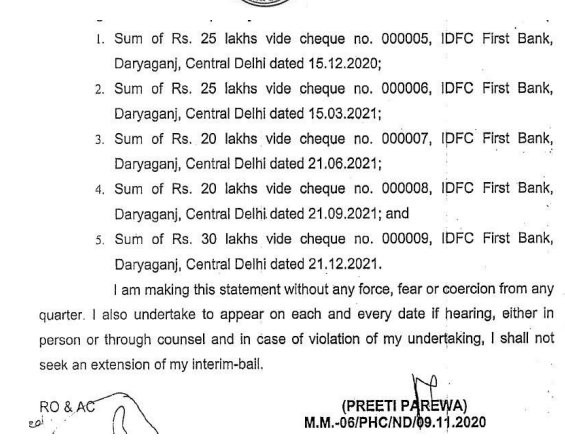

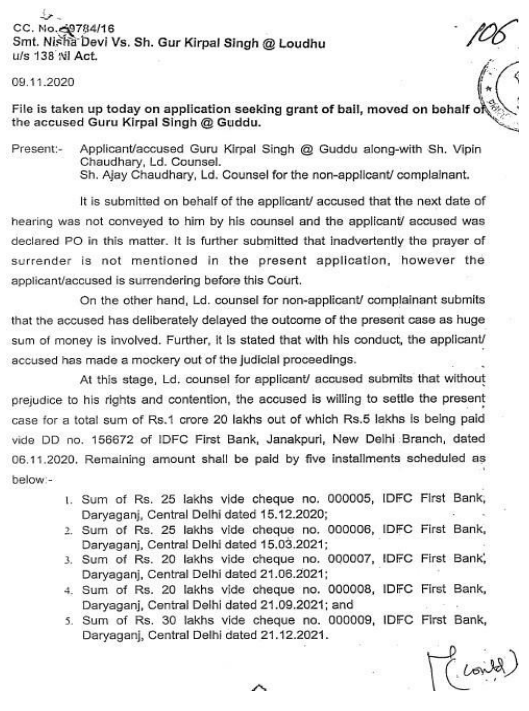
# 7. In Dayawati vs Yogesh Kumar Gosain (supra), the issue regarding legal permissibility of referring a complaint case under Section 138 NI Act for amicable settlement through mediation, procedure to be followed upon settlement and the legal implications of breach of mediation settlement were considered. Observations in paras 104 to 107 may be beneficially reproduced:
“104. Binding the parties to a settlement agreement entered into through a formal mediation process and being held accountable for honouring the same is really enforcing the legislative mandate in enacting Sections 138 and 147 of the NI Act i.e. to ensure an expeditious time bound remedy for recovery of the cheque amounts. Breach of a lawful entered agreement would not only frustrate the parties to the mediation, but would be opposed to the spirit, intendment and purpose of Section 138 of the NI Act and would defeat the ends of justice. The courts cannot permit use of mediation as a tool to abuse judicial process.
105. There is no legal prohibition upon a criminal court seized of such complaint, to whom a mediated settlement is reported, from adopting the above procedure. Application of the above enunciation of law to a mediation arising out of a criminal case manifests that a settlement agreement would require to be in writing and signed by the parties or their counsels. The same has to be placed before the court which has to be satisfied that the agreement was lawful and consent of the parties was voluntary and not obtained because of any force, pressure or undue influence. Therefore, the court would record the statement of the parties or their authorized agents on oath affirming the settlement, its voluntariness and their undertaking to abide by it in the manner followed by the civil court when considering a settlement placed before it under Order XXIII Rule 3 of the CPC. The court would thereafter pass an appropriate order accepting the agreement, incorporating the terms of the settlement regarding payment under Section 147 of the NI Act and the undertakings of the parties. The court taking on record the settlement stands empowered to make the consequential and further direction to the respondent to pay the money in terms of the mediated settlement and also direct that the parties would remain bound by the terms thereof.
106. In having so proceeded, there is a satisfaction of the voluntariness and legality of the terms of the settlement of the court and acceptance of the terms thereof as well as a specific order in terms thereof. Consequently, the amount payable under the settlement, would become an amount payable under an order of the criminal court.
107. So far as the disputes beyond the subject matter of the litigation is concerned, upon the settlement receiving ‘imprimatur’ of the court, such settlement would remain binding upon the parties and if so ordered, would be subject to the orders of the court.”
# 8. On the face of record, the observations in Dayawati vs Yogesh Kumar Gosain (supra) which are germane for consideration relate to a mediated settlement and procedure to be followed in this regard, in case, the matter is referred to mediation. Thereupon, it becomes imperative for the Court to be satisfied that not only the agreement is lawful but the same is with the consent of the parties and was voluntary without any force, pressure or undue coercion. As such, it was observed in Dayawati vs Yogesh Kumar Gosain (supra) that the Court would record the statement of the parties or their authorized agents on oath affirming the settlement, its voluntariness and undertaking to abide by it, followed by an appropriate order accepting the agreement. Further, the Court taking on record the settlement stands empowered to make consequential directions, if required.
# 9. The position in regard to ‘mediation settlement agreement’ in cases permissible to be forwarded under the Mediation Act, 2023 and ‘outcome of mediation’ in reference to ‘criminal cases’ may also be beneficially noticed.
Under Section 26 of the Mediation Act, 2023, the ‘mediation settlement agreement’ resulting from mediation signed by the parties and authenticated by the Mediator is final and binding between the parties and is enforceable under the provisions of Code of Civil Procedure, 1908 by virtue of Section 27 of the Mediation Act, 2023, in the same manner as if it were a ‘judgment or a decree’ passed by the Court. However, the ‘outcome of mediation’ in respect of compoundable offences forwarded for mediation shall not be deemed to be a judgment or a decree and shall be further considered by the Court in accordance with law for the time being in force, under second proviso to Section 6 of the Mediation Act, 2023. The reason for not deeming the outcome of such mediation in criminal case as a decree or judgment, is that criminal offences are generally considered as offences against the society and State, in respect of which the matter requires a larger consideration by the Court. As such, even though offence under Section 138 N.I. Act is quasi criminal in nature, the ‘outcome of settlement’ in mediation is required to receive imprimatur or authoritative approval of the Court, in case the proceedings are settled in mediation.
# 10. However, it is important to underscore that wheresoever, compromise/ settlement/compounding itself is recorded by the Court, it is inherent that Court is satisfied that the settlement is lawful and has been voluntarily entered between the parties. Having satisfied itself as to the voluntariness and legality of the settlement and recording the necessary statement/undertaking, the settlement becomes binding on the parties and cannot be retracted or resiled until and unless sufficient reasons are shown to reasonably infer that the settlement was under threat, pressure or coercion.
# 11. There is no bar that unless the matter is forwarded to mediation for settlement, the same cannot be entered before the Court itself. The Court only needs to be satisfied that the settlement is lawful and consent of the parties is voluntary and not obtained under coercion or undue influence.
Even when the Court permits the compounding of an offence, which is permissible under NI Act, there is no bar that the Court cannot compound the offence without forwarding the matter to mediation. When the matter is not forwarded to mediation but the Court records the settlement or compounds the offence, it is obvious that the proposal receives ‘imprimatur’ or authoritative approval of Court.
Learned Trial Court failed to consider the true import of the scope of observations in Dayawati vs Yogesh Kumar Gosain (supra).
# 12. A bare perusal of order dated 09.11.2020 reflects that the settlement was proposed on behalf of the respondent/accused in presence of his counsel for a total sum of Rs. 1.20 crore out of which Rs. 5 lacs was paid vide DD dated 06.11.2020 to the petitioner/complainant. The terms of the settlement were accepted on behalf of the petitioner/complainant on undertaking by the respondent. The statement of the respondent was also separately recorded and the remaining post-dated cheques were also handed over to the petitioner. In his statement, the respondent stated that the same was made without any force, pressure or coercion and executed the settlement for Rs. 1.20 crore.
In the facts and circumstances, there does not appear to be any reason to presume that the settlement was ‘not voluntary’ or under any force, pressure or coercion. The fact that the respondent had come with a DD dated 06.11.2020, which was handed over to the petitioner/complainant on 09.11.2020 reflects that he had already made up his mind to settle the issues. Once the said settlement was accepted by the petitioner and also received ‘imprimatur’ of the Court, there does not appear to be any reason for the Court to arrive at a contrary conclusion vide impugned order dated 19.12.2020 that there was no effective settlement bringing criminal proceedings to an end. The settlement was legal and voluntary without any force, pressure or coercion. The proceedings after settlement between the parties vide order dated 09.11.2020 were only for the purpose of ensuring the compliance of settlement by the parties.
# 13. In view of the above, this Court is of the considered opinion that once a valid settlement stood recorded, the consequences of the same are bound to ensue and as such, on default or non-compliance or breach of settlement, learned MM is bound to pass an order under Section 421 read with Section 431 Cr.P.C. to recover the amount agreed to be paid by the respondent/accused in the same manner, as a fine would be recovered as held in Dayawati vs Yogesh Kumar Gosain (supra). If the settlement recorded before the Court is not held to be binding, the same would result in a mockery of process of law, whereby, the accused would be permitted to blow hot and cold and take entire system for a ride at his own discretion.
# 14. The judgments relied upon by the learned counsel for the respondent, Rajkumar Kuchhal vs. Loyal Logistics Pvt. Ltd. and Vikas Aggarwal vs. Tripurari Mani Tripathi, (supra) are distinguishable on facts.
In Rajkumar Kuchhal vs. Loyal Logistics Pvt. Ltd. (supra), midway of proceedings, the parties entered into settlement agreement in Mediation Cell. It was noticed by the Co-ordinate Bench of this Court that no formal settlement of the parties was recorded, nor any enquiry held as to the voluntariness of the settlement. As such, it was held that there was nothing shown, by which it could be inferred that settlement had the ‘imprimatur’ of the Court.
Similarly, in Vikas Aggarwal vs. Tripurari Mani Tripathi, (supra), it was noticed in para 8 that no formal proceedings were drawn by learned Magistrate with reference to the settlement through mediation, no enquiry was made by learned MM as to the voluntariness of the settlement, nor any effective order was passed adopting the said settlement.
However, in the present case, the settlement has been duly recorded by the learned MM himself and also the statement of the respondent/accused was recorded in presence of his counsel. The parties further acted in furtherance of same as DD for Rs.5 lacs was handed over by respondent/accused to petitioner/complainant.
# 15. For the foregoing reasons, impugned order dated 19.12.2020 passed by learned MM is set aside. The settlement between the parties in terms of order dated 09.11.2020 is binding. Accordingly, application under Section 421 read with Section 431 Cr.P.C. shall be considered by the learned Trial Court in accordance with law.
Petition is accordingly disposed of. Pending applications, if any, also stand disposed of.
A copy of this order be forwarded to the learned Trial Court for information and compliance.
---------------------------------------------
